
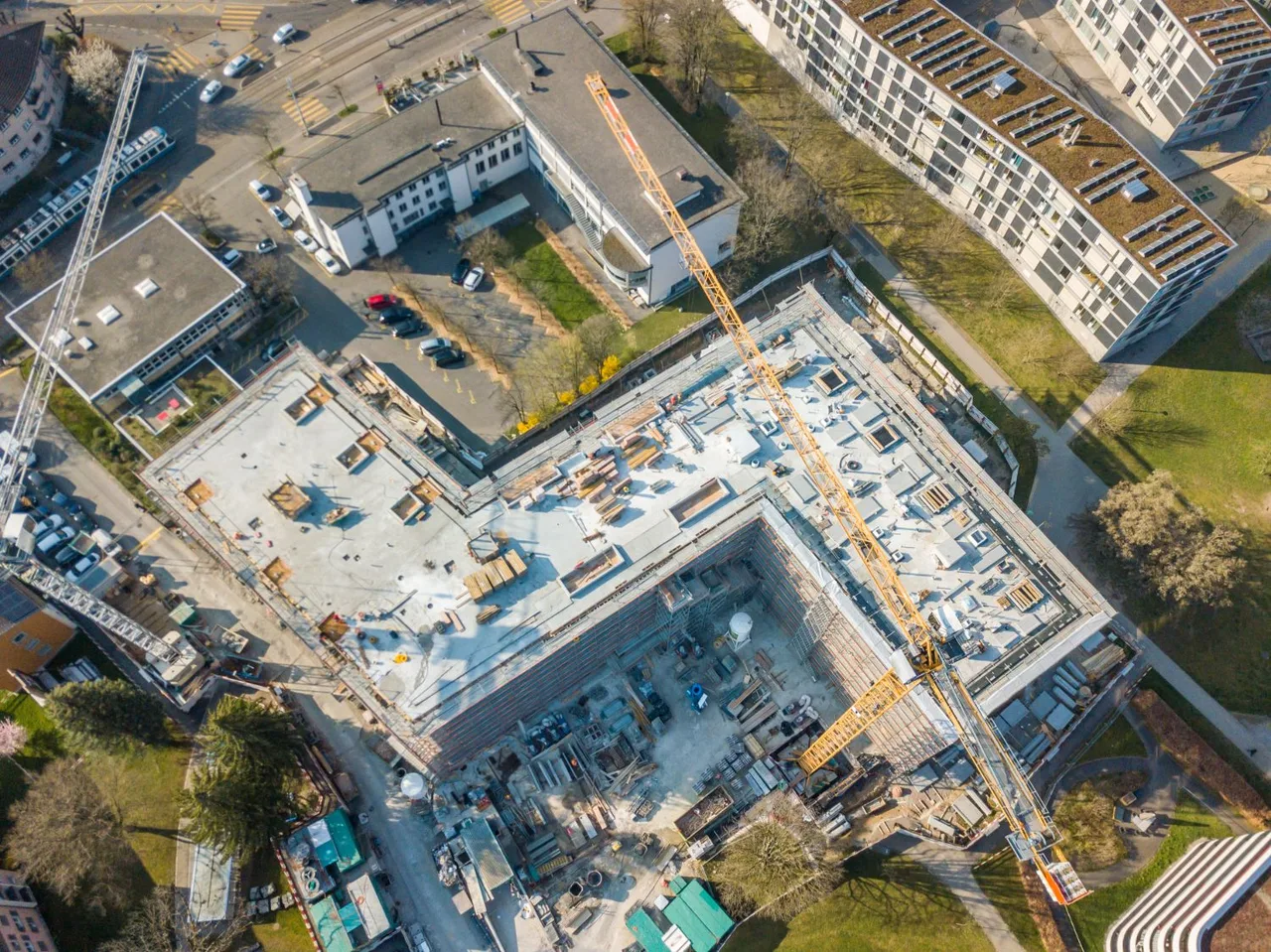
Yes, construction cameras are allowed in Switzerland — under conditions. A camera needs a clear purpose, must be used proportionately and announced with visible signage. Workers may not be monitored in their behaviour, recordings are kept only as long as necessary, and neighbours and public space stay out of the picture wherever possible.
The question comes up on almost every project. What counts is the Swiss Data Protection Act (nDSG, also known as revFADP), the guidance of the Federal Data Protection and Information Commissioner (FDPIC, in German EDÖB) and, for workplaces, Ordinance 3 to the Employment Act (ArGV 3). The rules depend less on the camera than on its purpose: a camera documenting progress is judged differently from one securing the site at night.
General information, not legal advice. For a specific case, check with your legal adviser or the responsible authority. Outside Switzerland, local data-protection law applies — in the EU the GDPR — with the same principles of purpose, proportionality and signage.
What applies to documentation and timelapse?
For documentation and timelapse, a construction camera is readily permissible, because its purpose is the building and not the people on it. The camera records which construction stage existed when — for the client, handovers and communication. People appear at the edge at most and are not the subject of the image.
The nDSG still applies as soon as people are recognisable. Three points keep the use clean: the camera faces the building, not break areas or site containers. The resolution serves the structure, not the identification of individuals. And anyone publishing a timelapse film makes sure that people and vehicles in it cannot be recognised.
What applies to security surveillance?
Security surveillance is permissible when it protects a legitimate interest and goes no further than necessary. Theft of material, tools and cable or vandalism are such interests. Proportionate means: the camera covers entrances, storage and machine positions, not the whole neighbourhood.
It also makes sense to limit detection to times when nobody should be on site. The more an installation intrudes on privacy, for instance with audio recording or continuous tracking of walkways, the harder it is to justify. For extensive surveillance, a data protection impact assessment under the nDSG may be required.
May workers be filmed?
Workers may appear in the picture on site, but their behaviour may not be monitored. Article 26 of ArGV 3 prohibits monitoring and control systems intended to monitor behaviour at the workplace. Where such systems are needed for other reasons, such as security, they must be designed and placed so that the health and freedom of movement of workers are not impaired.
In practice this means: no camera aimed specifically at a workstation, the workshop or the break room. No analysis of who worked when and for how long. And clear information to every company on site before the camera goes live. Involving subcontractors and worker representatives early avoids discussions on site.
What signage is required?
Clearly visible signs are required at every entrance, before anyone enters the recorded area. The nDSG requires transparency: people being filmed should be able to recognise it.
A good sign states three things: that a camera is recording, who is responsible for it and where to get information. The responsible party is usually the client or the general contractor. The contact address must be reachable, because the people concerned have a right of access to the recordings. The camera also belongs in the site rules and the kick-off meeting.
How long may recordings be kept?
Recordings may be kept only as long as their purpose requires. The law sets no fixed period; the purpose is what counts. Security recordings without an incident have served their purpose once it is clear that nothing happened, and are deleted after that.
If a theft occurs, the relevant sequences may be kept for the police and the insurer until the case is closed. Documentation and timelapse serve a different purpose: images of the building are often archived for the entire construction period and beyond. So people should not be recognisable in them. Set down the retention periods per purpose in writing before the installation starts.
What applies to neighbours and public space?
Neighbouring properties and public space generally do not belong in the picture of a private construction camera. Filming a street, pavement or a neighbour's window intrudes on the privacy of people who have nothing to do with the site.
Camera direction and framing are therefore the most important tools: the camera shows your own site, adjacent areas are cropped out or masked. If a strip of public ground cannot be avoided, it stays as narrow as possible and people in it unrecognisable. For cameras that show public space, cantonal and municipal rules may also apply — clarify this with the municipality in advance.
How does Arclap support this?
Arclap provides the technology that makes privacy-compliant use easier; the client or contractor remains responsible for purpose and signage.
- Automatic blurring. People and vehicles are made unrecognisable automatically; access to unblurred material is strictly controlled.
- Role-based access. Only invited people see the images, per project and with a personal login.
- Swiss hosting. All data stays on servers in Switzerland, nDSG-compliant.
- Alignment at commissioning. We align and test the camera remotely — the right moment to limit the framing to your site.
Suitable systems: the live & timelapse kits for documentation, the security stations for security. The security layers are covered in construction site security.
Does a construction camera need a permit?
Usually not. A private construction camera must, however, follow the principles of the nDSG: a clear purpose, proportionality, transparency and data security. If the camera shows public space, cantonal or municipal rules may apply.
May the camera show people recognisably?
Only as far as the purpose requires. Documentation and timelapse do not need recognisable people; with automatic blurring they stay unrecognisable. After an incident, access to unblurred material can be justified, but it belongs in few hands.
Do workers have to be informed?
Yes. Every company and worker on site should know before the start where cameras are, what they are for and who has access. This creates transparency and helps stay clear of the prohibited behaviour monitoring under ArGV 3.
Who is responsible for data protection?
The party that decides on the purpose and use of the camera, usually the client or the general contractor. Arclap provides camera, platform and hosting and supports with automatic blurring, role-based access and Swiss servers.
Where can I get binding advice?
From the FDPIC, from the cantonal data protection office when a public authority is the client, or from your legal adviser. This article is general information, not legal advice.