
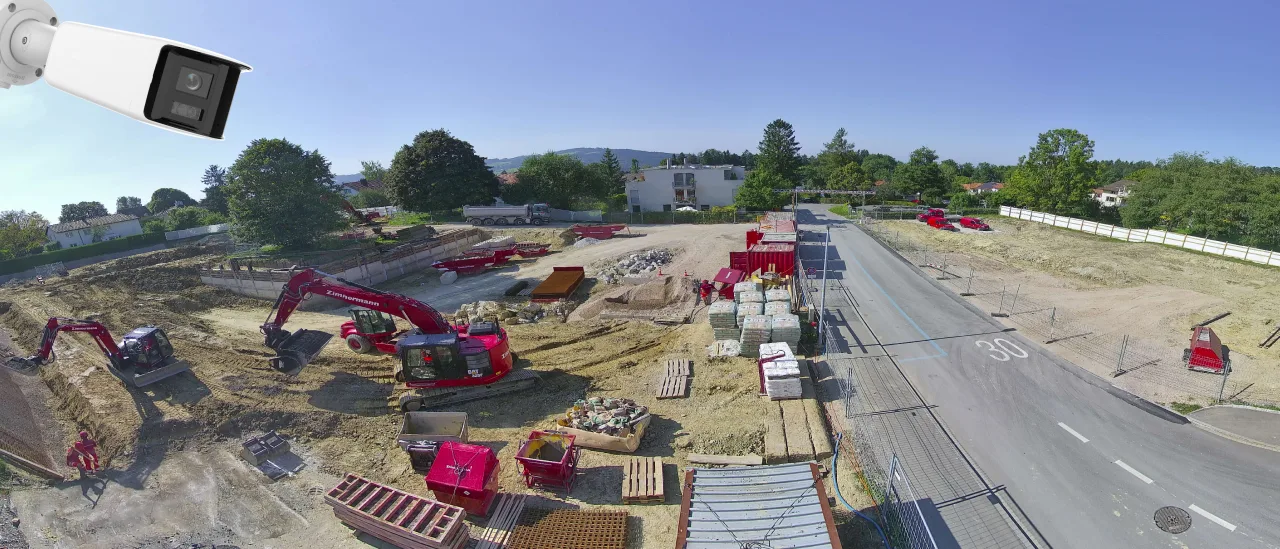
A construction camera is a weatherproof camera that documents a construction site automatically over the entire build — with live view, timelapse and photo archive. Five points decide the choice: resolution, field of view, power supply, data connection and nDSG compliance.
Every week we visit sites running the wrong camera: a cheap webcam that can't survive winter, a security camera pretending to do timelapse, or a premium DSLR pointed at ten metres of scaffolding. The camera itself is rarely the problem — the decision process is. Here are the five questions that matter.
1. What is the image for?
Documentation, marketing or security — pick your primary purpose first. A documentation camera needs consistent daily photos and a clean archive. A marketing camera needs cinematic resolution — our DSLR Capture Kit L (from 24 MP) produces 6000×4000 frames that hold up on a cinema screen. A security camera needs night vision, detection zones and someone who reacts at 02:00. One camera can do two of these jobs well; no camera does all three equally.
2. How wide is the site?
A standard motorised-zoom station with a 99°–43° viewing angle covers a typical building footprint from one corner. Wide, open sites — logistics halls, infrastructure, multi-building developments — are panorama territory: one 180° station replaces two conventional cameras, with no stitching seams down the middle of your timelapse.
3. Where does power come from?
The most underestimated question. Site power moves, gets cut, and disappears exactly when the crane arrives. If there's any doubt, go solar: a 330 W module with battery buffer runs a capture station year-round in Swiss conditions — we've yet to see a winter kill one. For sites with no fixed structures at all, a mobile tower carries up to four cameras and its own power.
4. How does the image leave the site?
Site WiFi is a rumour. Plan for 4G/5G from day one: 30 GB per month covers standard intervals, 50–100 GB covers DSLR quality and high-frequency capture. A dedicated SIM per station means your documentation never competes with the site office's video calls.
5. Is it legal?
In Switzerland, the nDSG applies the moment identifiable people or licence plates appear in your images. The clean answer is automatic anonymisation at the source — our Privacy Shield blurs people and vehicles before an image is stored. Add Swiss hosting (our archive lives on AWS Zürich) and your data-protection officer signs off in one meeting. Outside Switzerland, the same set-up supports GDPR compliance.
The short version
- Purpose first: documentation, marketing or security
- Panorama for wide sites, DSLR for showcase projects
- Solar unless power is guaranteed — which it never is
- 4G/5G with a dedicated SIM, sized to your interval
- Anonymisation + Swiss hosting = nDSG done
About the figures: data volumes, solar sizing and camera coverage are guide values from Arclap projects; your site may differ.
Read on:Construction cameras at a glance · Time-lapse camera · Systems catalogue · Request an offer